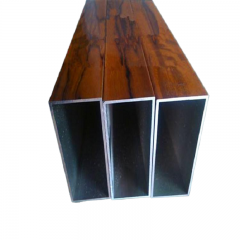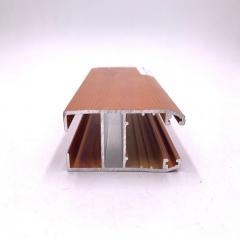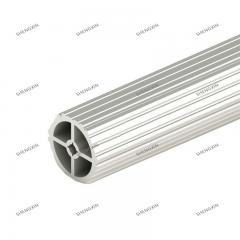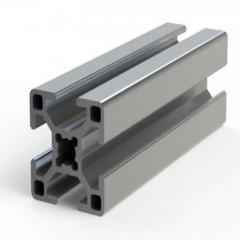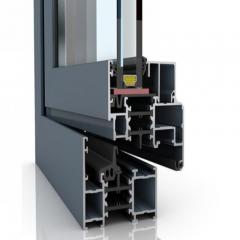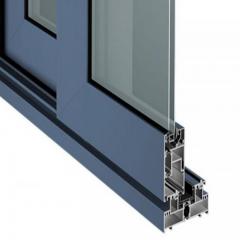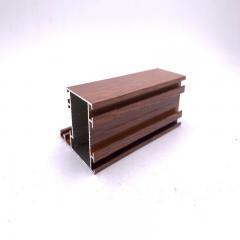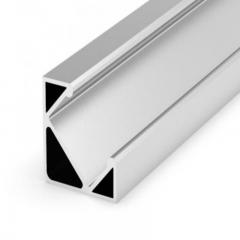
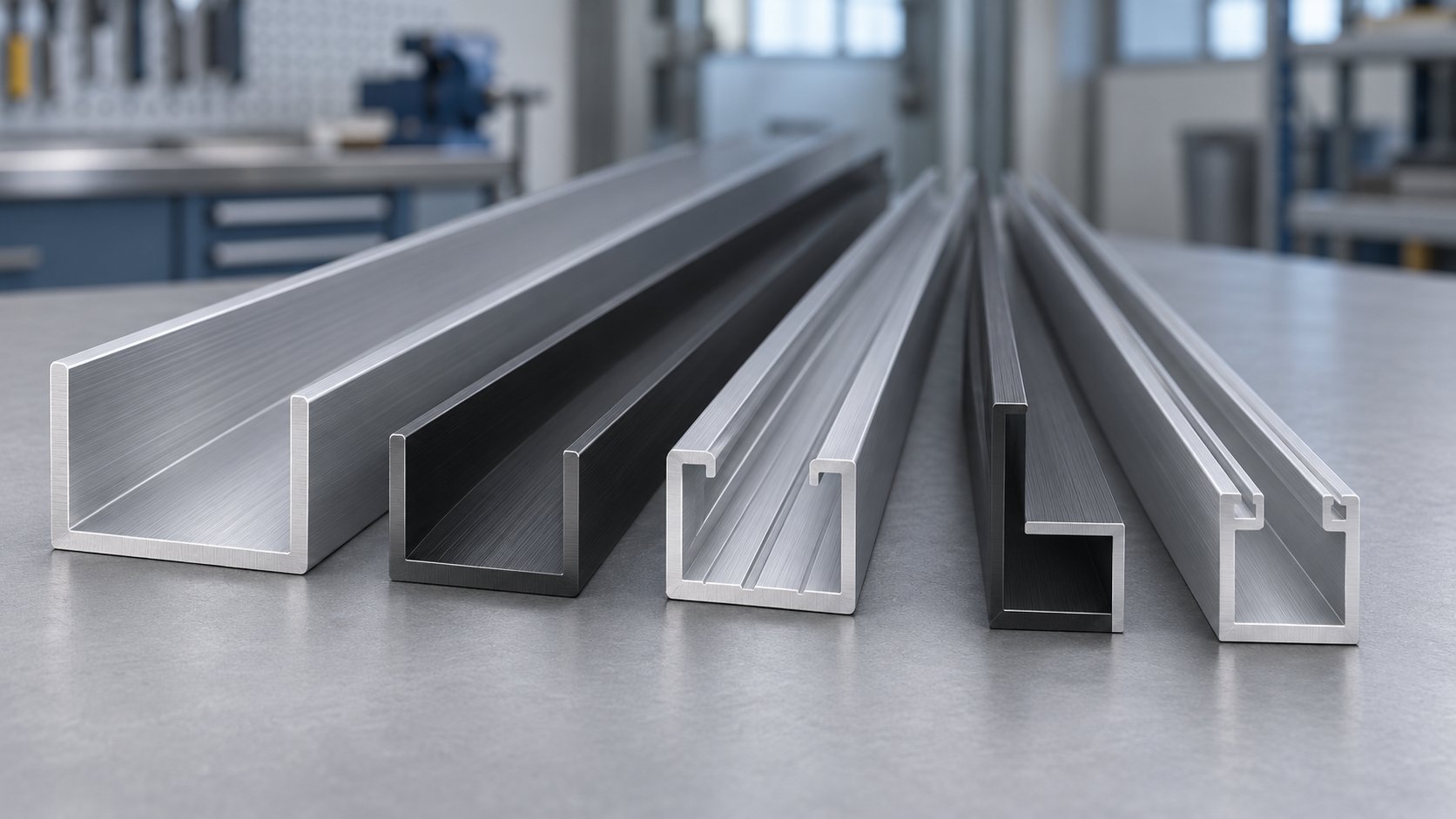
Have you ever slid a cabinet door along its track or noticed the slim metal groove holding a glass panel in place? Chances are, you were looking at an extruded channel. It is one of the simplest shapes in metalworking, and one of the most useful.
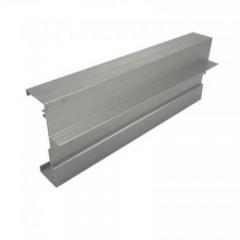
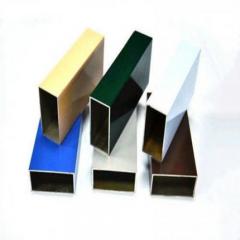
Extruded aluminium channels are open-section aluminum profiles made by pushing a heated billet through a shaped die, creating a constant cross-section, usually a base with one or more legs, along the full length of the part.
A quick note on spelling. "Aluminum" is the US form, and "aluminium" is the UK and international form. They are the same metal. You'll see both in this guide, and sizes appear in both metric and imperial units so readers anywhere can follow along.
A channel is an open section. It has a base, also called the web, and one or more legs, often called flanges. A U channel has two legs rising from the base, creating a slot that can grip a panel or guide a moving part. You'll also see an L channel listed in many catalogs, although it is really an angle: two legs meeting at a corner, with no web between them.
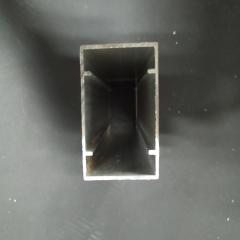
Channels differ from other common shapes in simple ways. Tubes are closed and hollow. Solid bars have no open space at all. Because a channel is open on one side, it can receive, hold, cover or guide something else, which is exactly why designers reach for it so often.
Sounds complex? Picture a modeling-dough press. The Aluminum Extruders Council uses that very image: soft material is forced through a shaped opening and comes out in that shape. Real aluminum extrusion follows the same idea in a few controlled steps:
Since every inch passes through the same die opening, the cross-section repeats along the whole length. That consistency is the core advantage of extruded aluminum profiles.
Look around a building, a vehicle or a shop floor, and you'll notice channels doing quiet work in categories like these:
This guide is vendor-neutral and educational. Instead of reading like a catalog, it explains the concepts first, so you can compare extruded aluminum profiles with confidence before you buy. And that starts with the word "extruded" itself, because not every channel that looks the same on a shelf was made the same way.
Hold two U channels side by side. Same width, same leg height, same silver finish. Are they the same part? Not necessarily. One may have been extruded, and the other may have started life as a flat sheet that was bent into shape. That difference shows up in the corners, the tolerances and the features each one can carry.
Roll forming feeds flat sheet through a series of mated roller dies that bend it gradually into a continuous profile. Brake forming, often called press braking, pinches sheet between a punch and a die to fold it one bend at a time. Both methods start flat and end bent. An extruded aluminum channel is different. It is formed as one solid cross-section the moment it leaves the die, so the base and legs never pass through a bending step.
| Factor | Extrusion | Roll Forming | Brake Forming |
|---|---|---|---|
| Corner sharpness | Near-square corners possible | Bend radius tied to sheet thickness | Bend radius tied to sheet thickness |
| Achievable tolerances | Very tight and repeatable | Very tight | Looser, operator-dependent |
| Wall thickness variation | Can vary within one profile | Uniform (set by sheet) | Uniform (set by sheet) |
| Design freedom | High: grooves, screw bosses, ribs, unequal walls | Moderate: complex bends, no thickened features | Low: simple bends only |
| Tooling cost | Relatively low die cost | Higher, offset at volume | Low |
| Best run length | Short to long runs | Medium to high volume, no length limit | Small volumes, shorter parts |
These trends match the comparison published by Dahlstrom Roll Form, a roll-forming specialist that still credits extrusion with tight tolerances, wall thickness control and low tooling costs. It also notes that press braking tends to leave tool marks and is less repeatable.
Every bend in sheet metal has an inside radius. Push it too tight, and the metal cracks. A common rule of thumb from Xometry sets the minimum inside radius for 1 to 6 mm aluminium sheet at roughly one times the sheet thickness. So a 3 mm bent channel carries about a 3 mm rounded inside corner. Imagine sliding a square-edged panel into that slot: it rides up on the curve instead of seating flat.
Aluminum extrusions avoid this limit. The die can cut near-square inside and outside corners, and every length repeats the same shape. That is why an alu channel built to retain glass or panels so often comes from a die rather than a brake.
Extrusion is not always the answer. Formed sheet is a sensible choice when:
Plastic U channel extrusions also exist, usually rigid PVC that pushes onto panel edges for light-duty trim. They are cheap, light and moisture-resistant. An aluminum U channel, however, is far stiffer and holds its shape under heat that would soften PVC, which is why aluminium earns its place where load or wear matters.
Choosing extrusion only settles how the channel is made. The die can produce dozens of shapes, and the names suppliers give them, from U and C to J and hat, are where many buyers first get lost.
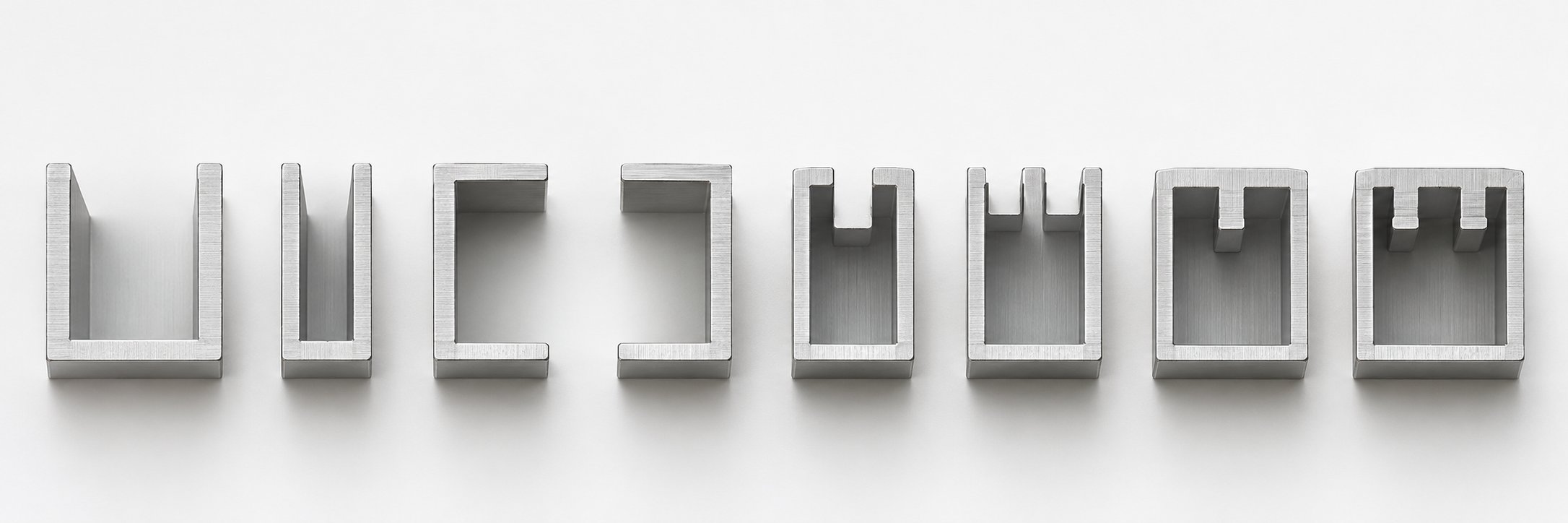
Have you ever searched for a U channel, then found the exact same shape listed as a C channel two clicks later? You're not imagining it. Channel names are loose, so it helps to know what each letter usually means and where the labels break down.
A plain U-channel has a flat base and two straight legs. The legs usually sit perpendicular to the base, often with square inside corners. That simple slot works well as a panel receiver, an edge guard or a basic track.
A C channel is trickier. Sometimes it means the same shape. Other times it describes a section with short, inward-turned lips that make the mouth narrower than the cavity behind it. Those lips can trap clips, rollers or sliding panels. In structural catalogs, an aluminum c channel may also mean a heavier shape with tapered flanges.
None of these names is a universal standard. As Clinalu points out, some markets sell the same open three-sided extrusion under both names. Neither letter is automatically stronger, either. Dimensions, orientation, alloy, temper and load direction decide performance. Treat the drawing, not the name, as the real specification.
Beyond U and C, you'll meet a whole alphabet of shapes:
An equal-leg channel has two legs of the same height. Kogee AL gives the example of a 50 mm base with two 25 mm legs. The symmetry delivers balanced support and a uniform look, which suits frames, edge protection and equipment covers. An unequal-leg version, say a 60 mm base with 40 mm and 20 mm legs, solves specific problems: one side needs more support, space is tight, or parts connect at different heights. Neither design is better across the board. The job decides.
Corners matter just as much. Square inside corners let a flat panel seat fully against the base. A small inside radius, on the other hand, reduces stress concentration where the leg meets the base. Rounded outside corners take finishes more evenly and feel safer on edges people touch. Imagine a glass shelf held in an alu u channel: square inside for clean seating, lightly eased outside for hands and coatings.
When you compare u channel sizes and shapes across catalogs, this summary keeps the options straight:
| Profile Type | Best-Fit Application | Key Detail to Check |
|---|---|---|
| U channel | Panel retention, edge trim, simple tracks | Inside width and corner style |
| Lipped C channel | Retaining clips, rollers and sliding hardware | Mouth width versus cavity width |
| J channel | Edge capping and finishing | Long-leg length |
| Hat channel | Furring, stand-off mounting, cladding support | Depth and flange width |
| L channel | Corner protection | Leg length and thickness |
| T channel | Joints and dividers | Stem height |
| Z channel | Offset mounting and cleats | Offset depth |
| H channel | Joining two panels | Both slot widths |
| LED channel | Strip lighting housings | Strip width and diffuser groove |
Shape tells only half the story, though. Two U channels can share an outline yet be built for very different jobs, one for neat trim and the other for carrying load, and that split comes with its own vocabulary.
When you browse aluminum channel specifications, two labels keep popping up: architectural and structural. They sound like marketing terms, but they describe real differences in shape, sizing and purpose. Pick the wrong one, and a panel may refuse to seat or a bracket may flex more than you expected.
Architectural channel is the clean-lined version. Its legs run parallel, its wall thickness stays uniform, and its inside and outside corners are square or nearly square. Many suppliers sell it as "Aluminum Association" or sharp-corner channel, typically in 6063-T52. Because the opening stays the same width from the leg tips down to the base, caps, infill panels and mitered joints fit flush. It is usually specified by outside dimensions: base width, leg height and wall thickness. A catalog listing for a 1 1/2 aluminum U channel or a 1 U channel almost always describes this style. It shines in trim, framing, glazing and display work, where appearance and fit matter most.
Structural channel looks similar from across the room. Up close, you'll notice the flanges taper, thinning toward the tips, with rounded fillets where they meet the web. That geometry puts metal where bending loads need it. These American Standard shapes are commonly produced in 6061-T6 and are specified by depth and weight per foot rather than by a simple outside width. Despite the overlapping trade name, the Aluminum Association also publishes standard dimensions and section properties for structural shapes in references such as Aluminum Standards and Data and the Aluminum Design Manual. Always confirm aluminum C channel dimensions against those tables or the supplier's drawing.
The taper has a practical side effect. As Cut2Size Metals explains, the inside opening narrows toward the web, so a part that slips in at the tips can pinch near the base. Measure depth, leg width at the tips and web thickness, then leave clearance where parts must nest.
| Factor | Architectural Channel | Structural (American Standard) Channel |
|---|---|---|
| Cross-section geometry | Parallel legs, uniform walls, square corners | Tapered flanges, fillets at web-to-flange junction, larger inside radii |
| Typical specification | Outside base width x leg height x wall thickness | Depth and weight per foot |
| Typical alloy and temper | 6063-T52 | 6061-T6 |
| Appearance | Crisp lines, excellent anodizing response | Functional, finish less uniform |
| Load use | Light duty: retaining, trimming, guiding | Load-bearing members and supports |
| Common applications | Trim, edging, frames, glazing, display fixtures, enclosures | Brackets, machine bases and guards, trailer framing, heavy supports |
Key takeaway: if the channel carries meaningful load across a span, start with structural shapes and engineering data; if it retains, trims or guides, architectural channel is usually the better starting point.
You may have noticed that each style tends to travel with its own alloy, 6063 on one side and 6061 on the other. That pairing is no accident, and the letters and numbers after the alloy name reveal even more about how a channel will behave.
Why would two channels with identical dimensions behave so differently on the job? The answer is often a short code, such as 6063-T52 or 6061-T6. Those few characters tell you how strong a channel is, how cleanly it machines and how good it will look after finishing.
The four digits name the alloy. The 6xxx series blends aluminum with magnesium and silicon. As Kloeckner Metals explains, magnesium adds strength, and silicon lowers the melting temperature. When the metal is heated and aged, these elements form tiny particles that strengthen it.
The letter and number after the dash describe the temper, or how the metal was processed after extrusion:
6063 is the architect's favorite. It flows through a die easily, so it holds fine detail, crisp corners and thin walls. It also takes anodized finishes well, and its lack of copper helps it resist corrosion. 6061 trades some of that finish quality for strength and machinability. Kloeckner's published data lists a yield strength of about 276 MPa (40,000 psi) for 6061 versus 214 MPa (31,000 psi) for 6063, Brinell hardness of 95 versus 73, and machinability of good versus fair.
Imagine a 2 inch U channel trimming a storefront panel. Appearance matters most, so 6063 is the natural fit. Now picture an aluminum slide track channel that will be drilled, tapped and loaded by rollers. That aluminium U channel is a stronger candidate for 6061.
Between these two sit alloys built for structural and transportation work. 6005A and 6105 offer medium-to-high strength while extruding more easily than 6061. 6082 is a leading structural alloy in Europe, with strength close to 6061. Strut-style framing, often searched as aluminum unistrut channel, is a good example of a load-carrying profile where these alloys are worth asking about.
| Alloy and Temper | Relative Strength | Extrudability | Machinability | Weldability | Corrosion Resistance | Anodizing and Finish |
|---|---|---|---|---|---|---|
| 6063-T5/T52 | Good | Excellent | Good | Very good | Excellent | Excellent |
| 6061-T6 | Excellent | Good | Very good | Very good | Very good | Good |
| 6005A | Very good | Very good | Good | Very good | Very good | Good |
| 6082-T6 | Excellent | Good | Very good | Very good | Very good | Good |
| 6105-T5 | Very good | Very good | Good | Very good | Very good | Good |
These are relative ratings for comparing options, not design values. For engineering work, use certified data from recognized standards or the supplier's mill certificate.
Welding caution: welding heat undoes the aging that gives T5 and T6 tempers their strength, softening the heat-affected zone around the joint.
The loss can be large. Alloy Metalworks cites a study in which a welded 6061-T6 joint lost more than 50% of its ultimate strength compared with the base metal. Plan for that reduced strength in welded designs, or use mechanical fasteners where full strength must be kept.
Even a perfect alloy choice can fail in practice, though. A channel that arrives a millimeter too narrow for its panel is the wrong part, no matter how well it anodizes.
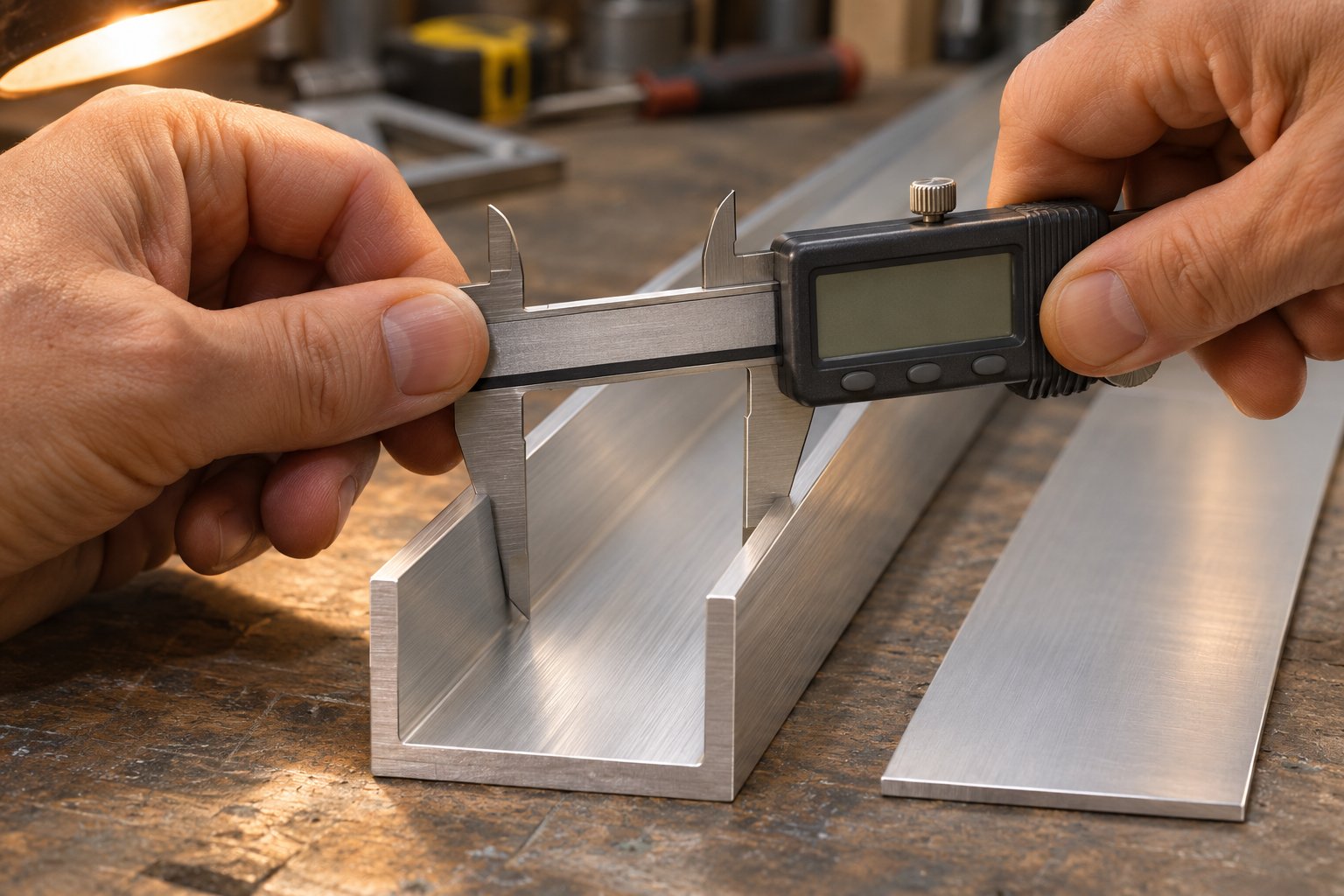
When you order a channel for a 1/2 in panel, which number are you actually matching? Most fit problems start here. Catalogs list aluminum channels sizes in different ways, and one misread number can leave you with a slot that is too tight to load or loose enough to rattle.
Five measurements describe almost every U channel:
A labeled cross-section diagram showing all five is the fastest way to keep you, your team and your supplier aligned. Here is the catch: some catalogs list outside dimensions, some list inside dimensions, and some list both. Mixing them up is one of the most common ordering mistakes. As Exalum Metal puts it, the outside width alone does not tell you whether the panel will fit. The Aluminum Association tables even treat a slot opening as a separate "space dimension" from a wall, or "metal dimension."
Need to match an existing part? Grab a set of calipers:
Many catalog sites group channels by what they "fit," such as a 1/2 aluminum channel listed for 1/2 in panels. That shortcut works only if the inside width covers everything going into the slot: panel thickness, plus any gasket, adhesive, glazing tape, or finish build-up on the panel or the channel itself.
Then decide on the fit. A slip fit leaves room to slide panels in and allows for thermal movement. A snug fit holds parts firmly without extra fasteners. Exalum notes that too much clearance allows movement and vibration, while an overly tight fit makes installation harder. The same logic applies to extruded aluminium rails that guide sliding parts.
No aluminium extrusion comes out exactly at its nominal size. Aluminum channel extrusions are produced to published tolerance standards, chiefly the Aluminum Association's ANSI H35.2 in North America and EN 755-9 in Europe. Tolerances in these standards scale with the size of the dimension and the profile, so larger channels allow more variation. Bor USA also advises stating whether a dimension applies before or after anodizing or powder coating.
Nominal sizes are labels, not guarantees. A channel described as 1/2 in (12.7 mm), 1 in (25.4 mm) or 1 1/2 in (38.1 mm) shows the naming format only. Real dimensions depend on the supplier's drawing and the cited standard. Design with clearance, cite the tolerance standard on your drawing, and you avoid building to a number the metal may never hit.
Getting the panel to fit, however, says nothing about what happens when that channel spans a gap and something presses down on it.
Imagine a 4 ft length of channel bridging two supports, with a row of tools resting on it. Will it hold? Will it sag? You don't need an engineering degree to follow what drives the answer. Three ideas do most of the work: weight, stiffness and span.
A channel's weight follows a simple rule: cross-sectional area times the density of aluminum gives weight per unit length. Aluminum weighs about 0.098 lb per cubic inch (2.70 g/cm3), so more metal in the cross-section always means a heavier part. Published tables from the Engineering ToolBox show how this plays out. A 2 x 1 in channel with 0.49 sq in of area weighs about 0.58 lb/ft, while a 4 x 2 in channel with 1.48 sq in weighs about 1.74 lb/ft.
Weight per foot shapes freight costs, how many lengths one person can carry, and the self-weight a long span must hold up before any real load arrives. It is also why structural shapes are named by depth and weight per foot.
Moment of inertia (I) describes how well a shape resists bending. Section modulus (S) links that shape to the bending stress it can handle. Both depend less on how much metal you have and more on where it sits. Metal placed far from the center, such as in tall legs, does the most work.
The same tables prove it. Going from a 2 x 1 to a 4 x 2 channel triples the weight, yet the strong-axis moment of inertia climbs from 0.288 to 3.91 in4, more than 13 times higher. You'll also notice that the 4 x 2 channel's weak-axis value is only 0.60 in4. Stand it with the web upright and it resists bending about six times better than when the web lies flat. Orientation matters just as much for l channel aluminum, whose stiffness depends on which leg lines up with the load.
When a channel needs more stiffness, designers reach for a few levers:
Research on cold-formed aluminium channels published in Thin-Walled Structures backs this up: raising web depth from 150 to 320 mm boosted moment capacity by roughly 300%, and increasing thickness from 1.5 to 2.5 mm about doubled it. This is where extrusion aluminum shines. A die can put ribs, lips and thicker walls exactly where they help, so slim 6063 aluminum channel extrusions can trim a panel while a heavier section carries a shelf.
Aluminum's elastic modulus is roughly 69 GPa (10,000 ksi), about one-third of steel's. Coupon tests in the same study measured values between about 66,600 and 69,400 MPa. In practice, a u channel aluminum part deflects about three times more than an identical steel shape under the same load. That's why deflection, not breaking strength, often governs the design. A channel can be nowhere near failure and still sag visibly.
Span magnifies everything. For a simply supported beam under an even load, deflection grows with the fourth power of span, so doubling the span multiplies sag by sixteen. Open channels can also twist. Their shear center sits outside the section, behind the web, so a load pushing down through the middle of the base, or off to one side, tends to roll the channel. Bracing, shorter spans or back-to-back pairs help control it.
Caution: this guide explains concepts, not design values; any load rating for extruded aluminium channels must come from engineering calculations to recognized codes such as the Aluminum Design Manual or Eurocode 9.
That same research found something every installer should know: web holes sized up to 60% of the web depth cut bending capacity by about 18% on average. And very few channels reach the job site without being cut, drilled or coated first.

A length of channel straight off the press is rarely ready to install. It usually needs to be cut, drilled and finished first. Each of those steps can change how the part fits, how long it lasts and even how green it is.
Most projects call for at least a few secondary operations:
Alloy and temper matter here more than many buyers expect. FS Fab describes 6061-T6 as machining with short, brittle chips, clean cuts and tight tolerances. Softer 6063 is gummier and tends to throw long, stringy chips. In practice, softer metal also smears and burrs more easily, so sharp tooling and a deburring step pay off. Imagine an aluminum track channel that needs dozens of tapped holes for roller hardware. 6061 will usually give cleaner threads with less cleanup.
| Finish | Appearance | Corrosion and Wear Protection | Color Options | Typical Uses |
|---|---|---|---|---|
| Mill finish | Raw metal, may show die lines | Natural oxide only, scratches easily | None | Hidden framing, parts to be finished later |
| Clear anodizing | Metallic, satin silver | Good corrosion and abrasion resistance, will not peel | Natural only | Trim, displays, architectural edging |
| Color and black anodizing | Metallic tint, black is popular | Similar to clear, slightly thicker layer | Bronze, black, gold and more, batch shades can vary | LED housings, furniture, consumer products |
| Powder coating | Opaque, matte to gloss, textured options | Strong impact and weather resistance, chips can expose metal | Wide range, RAL matching | Outdoor products, enclosures, color-matched framing |
| Brushed or polished | Linear grain or mirror shine | Low on its own, often sealed with clear anodizing | Metal tone | Decorative trim, signage, retail fixtures |
Why does 6063 look better after anodizing? Its leaner chemistry, with only trace copper, anodizes into a clear, even surface. FS Fab notes that 6061 can come out dull or slightly tinted, which is why visible trim leans toward 6063.
Finish thickness also eats into fit. Protolabs lists a minimum average thickness of 10 microns for clear Type II anodizing and 15 microns for black or color, while powder coating typically runs 50 to 150 microns. Coat both inner leg faces of a slot, and powder alone can narrow the opening by up to 0.3 mm. That is enough to turn a slip fit into a struggle. Mask tapped holes and mating surfaces, and state on your drawing whether dimensions apply before or after finishing.
Aluminum can be remelted and re-extruded again and again without losing its core properties. That makes scrap a valuable feedstock rather than waste. More extruders now offer recycled-content billet, and some offer primary billet made with lower-carbon power.
Claims are easy to make, so ask for documents. Useful requests include:
That last point matters. One published EPD for profiles made from low-carbon recycled billet lists mill finished, fabricated, anodised and painted profiles as separate variants. Finishing and machining add their own impact, so a mill-finish figure will not describe a powder-coated uchannel.
Every choice in this section, from the alloy you machine to the coating you specify, feeds back into fit, cost and environmental footprint.
Cut, coat and billet choices each make sense alone, yet they interact with profile, alloy and sizing decisions made earlier. Putting all of them in the right order is what turns a pile of good options into the right aluminum U-channel for the job.
Profile, alloy, size, finish, fabrication. By now, the list of variables is long. So where do you start when a real project lands on your desk? Start with the job, not the catalog. A channel that holds a glass shelf and a channel that guides a sliding door may look nearly identical, yet they answer very different questions.
Work through these decisions in order. Each one narrows the choices for the next.
This sequence lines up with guidance from Exalum Metal, which recommends weighing profile, load, indoor or outdoor exposure, fabrication method and finish together rather than one at a time. Skipping step one is the classic mistake. Imagine ordering a 1 inch aluminum U channel because it looks right on screen, only to discover the panel needs a gasket and the slot is now too tight to load.
Use this table as a starting point, then refine it with real aluminum channel dimensions taken from a supplier drawing.
| Application | Suggested Profile | Typical Alloy Direction | Finish Considerations | Key Sizing Variable |
|---|---|---|---|---|
| Panel retention | U channel with square inside corners | 6063-T5/T52 | Allow for coating build-up inside the slot | Inside width versus panel plus gasket or tape |
| Edge protection | U or J channel | 6063 | Anodized or powder coated, eased outside corners for touch | Leg height needed to cover the exposed edge |
| Framing | U channel for light duty, structural channel for loads | 6063 for light frames, 6061-T6, 6005A or 6082 for loaded frames | Powder coat for outdoor use or color matching | Leg height and wall thickness for stiffness |
| Sliding tracks | U or lipped C channel | 6061-T6 where drilled and tapped, 6063 for light hand-moved panels | Wear-resistant finish or low-friction liner in the slot | Clearance for rollers, sliders or liners |
| LED housings | Shallow U with diffuser grooves | 6063 | Clear or black anodizing for a uniform look | Strip width and diffuser groove position |
| Glazing | U or H channel | 6063-T5/T52 | Anodized or powder coated for humid or outdoor exposure | Glass thickness plus glazing tape or gasket |
These pairings reflect common practice. Clinalu describes U, H and Z channels as core components of glazing systems and notes that designers lean toward 6063 for lighting channels and decorative trim. The same source also stresses matching channel dimensions precisely to the glass, panels or siding they hold.
Aluminum channel track designs are everywhere: wardrobe doors, display panels, cabinet drawers and machine guards. Clinalu points to U-channels and box channels in residential sliding doors, commercial rail systems and cabinet drawers. A c slide track channel, with lips that trap rollers, keeps a door from lifting out of its path.
For quieter, smoother movement, many builders line the slot with a UHMW U channel. This low-friction plastic insert sits between the moving panel and the metal, cutting noise and wear. It is a simple upgrade for doors and panels moved by hand.
Know the limits, though. An open channel guides; it does not control motion precisely. Positioning accuracy, smooth travel under load and resistance to twisting come from bearings, hardened rails and carriages engineered as a matched system. Because open channels tend to twist under off-center loads, a plain U channel carrying a cantilevered carriage will rack and bind. If your application needs repeatable precision, specify a linear guide system and use the channel as a housing or mount, not as the guide itself.
Walk the eight steps, and you will have a clear mental picture of the right part. A picture in your head, however, is not something a supplier can quote or a press can produce. That requires putting every decision on paper in enough detail to leave no room for guesswork.
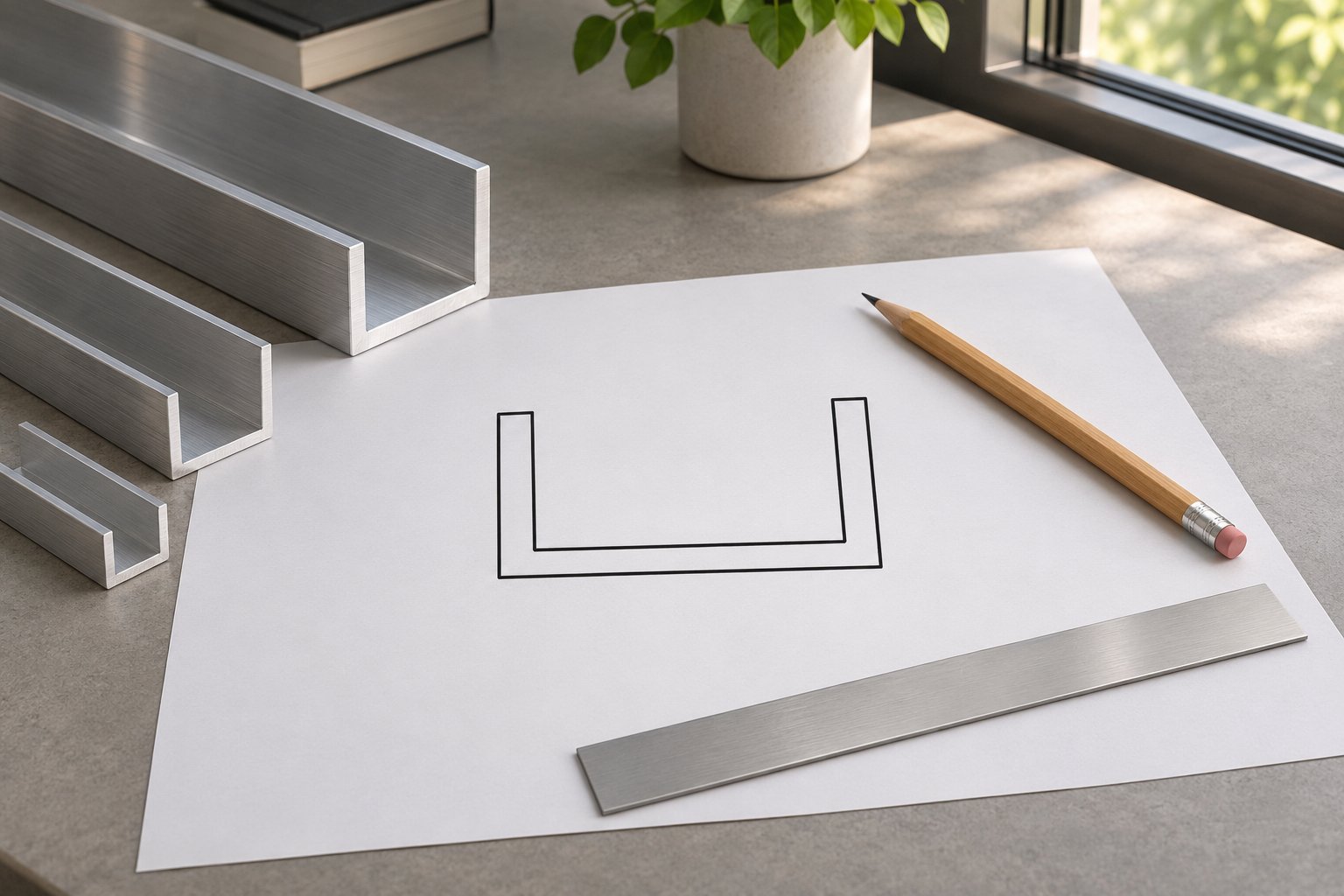
What does a supplier actually need from you? Less than you might fear, but a lot more than a part name. A short, complete specification turns every decision in this guide into a quote you can trust and a part that fits the first time.
Use this checklist for any aluminium channel order, whether it comes from stock or a new die:
Words alone leave gaps. A request for a 3 aluminum channel could mean a 3 in base, a 3 in leg or a 3 in overall depth. A dimensioned drawing removes that ambiguity in seconds. The same discipline applies if you are pricing a u shaped steel channel as an alternative, because the questions about fit and finish do not change with the metal.
Many extruders supply both standard and custom u-channels. Shengxin Aluminium is one example whose offering lines up closely with the checklist above. Its extruded aluminum U-channel profiles in 6063-T5 and 6061-T6 pair 6063-T5 for architectural and finish-focused work with 6061-T6 for higher strength and machining. The page shows representative standard sizes, custom dimensions, mill, anodized and powder coated finishes, plus cut-to-length, drilled, tapped and mitered configurations. Buyers can specify base width, leg height, wall thickness and mounting details to suit their assembly.
Keep expectations realistic. Shengxin states that its published drawings and dimensions are reference information only. Final dimensions, tolerances and finishes are confirmed on an approved production drawing. And a U-channel alone is not a complete precision linear-motion system. With any supplier, a new custom die is also a good moment to request trial samples and a dimensional inspection report before full production, a qualification step Aluphant recommends to reduce scrap and rework.
Define the function first, then choose the profile, alloy, size and finish, and confirm every detail on an approved drawing before production begins.
In many catalogs there is no real difference, because suppliers often sell the same open three-sided extrusion under both names. When a distinction is made, a U channel usually has straight legs at right angles to a flat base, while a C channel may have short lips turned inward that narrow the opening and trap clips, rollers or sliding panels. In structural catalogs, C channel can also refer to heavier shapes with tapered flanges. Neither name guarantees strength. Performance depends on dimensions, wall thickness, alloy, temper and the direction of the load, so always order from a dimensioned drawing rather than a letter.
Choose 6063 when appearance and detail matter most. It flows easily through the die, holds crisp corners and thin walls, and gives a more even, attractive anodized surface, which makes it the usual pick for trim, glazing, LED housings and display work. Choose 6061-T6 when the channel must carry load or will be drilled, tapped and machined heavily, since it is stronger and produces cleaner chips and threads. For loaded frames, alloys such as 6005A, 6082 and 6105 are also worth asking about. If the part will be welded, plan for lower strength near the weld, because welding heat reverses the aging that strengthens T5 and T6 tempers.
Match the inside width of the channel, not the outside width, to everything that goes into the slot. Add the panel thickness to any gasket, glazing tape, adhesive and coating build-up, then decide whether you want a slip fit that slides easily and allows thermal movement or a snug fit that holds without extra fasteners. Powder coating on both inner leg faces can noticeably narrow an opening, so state whether dimensions apply before or after finishing. Because extrusions are made to published tolerance standards such as ANSI H35.2 or EN 755-9, design with some clearance instead of relying on the nominal size printed in a catalog.
Use structural channel when the part spans a gap and supports a meaningful load, such as brackets, machine bases, trailer framing or heavy shelving. Structural shapes have tapered flanges and fillets that place metal where bending loads act, and they are specified by depth and weight per foot. Architectural channel, with parallel legs, uniform walls and square corners, is better for retaining panels, trimming edges and guiding light parts where fit and finish matter more than load capacity. Because aluminum is far more flexible than steel, sag often limits a design before strength does, so any load-bearing application should be checked by an engineer using the Aluminum Design Manual or Eurocode 9.
Yes for simple sliding tasks such as wardrobe doors, display panels, drawers and machine guards, especially when the slot is lined with a low-friction insert like a UHMW channel to reduce noise and wear. A lipped C profile can also keep a door from lifting out of its path. However, an open channel only guides movement; it does not deliver precise, repeatable motion under load, and it can twist when loads are off-center. For accurate positioning, use an engineered linear guide with bearings, hardened rails and carriages, and treat the channel as a housing or mount. Suppliers such as Shengxin Aluminium note this limit directly: their 6063-T5 and 6061-T6 U-channel profiles can be cut, drilled and tapped for track applications, but a U-channel alone is not a complete precision linear-motion system, and final dimensions and tolerances are confirmed on an approved production drawing.



 Onlineservice
 0086 136 3563 2360
 sales@sxalu.com
 +86 136 3563 2360
 Deutsch
 English
 français
 русский
 español
 português
 العربية
 ไทย
 Việt
 Українська