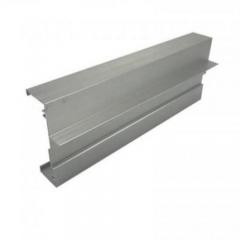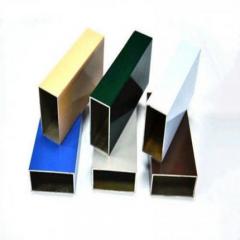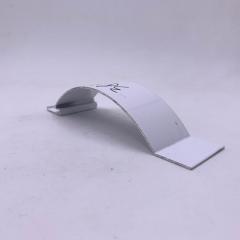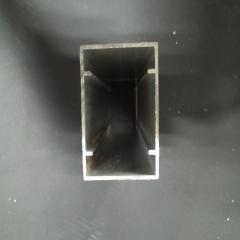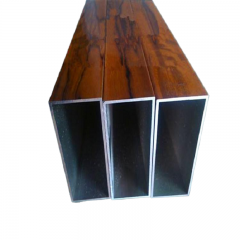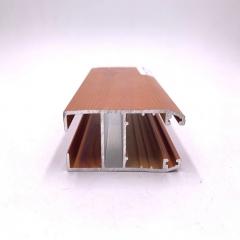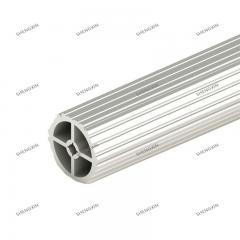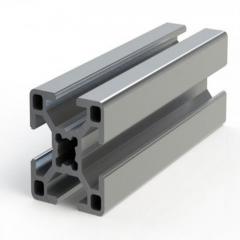
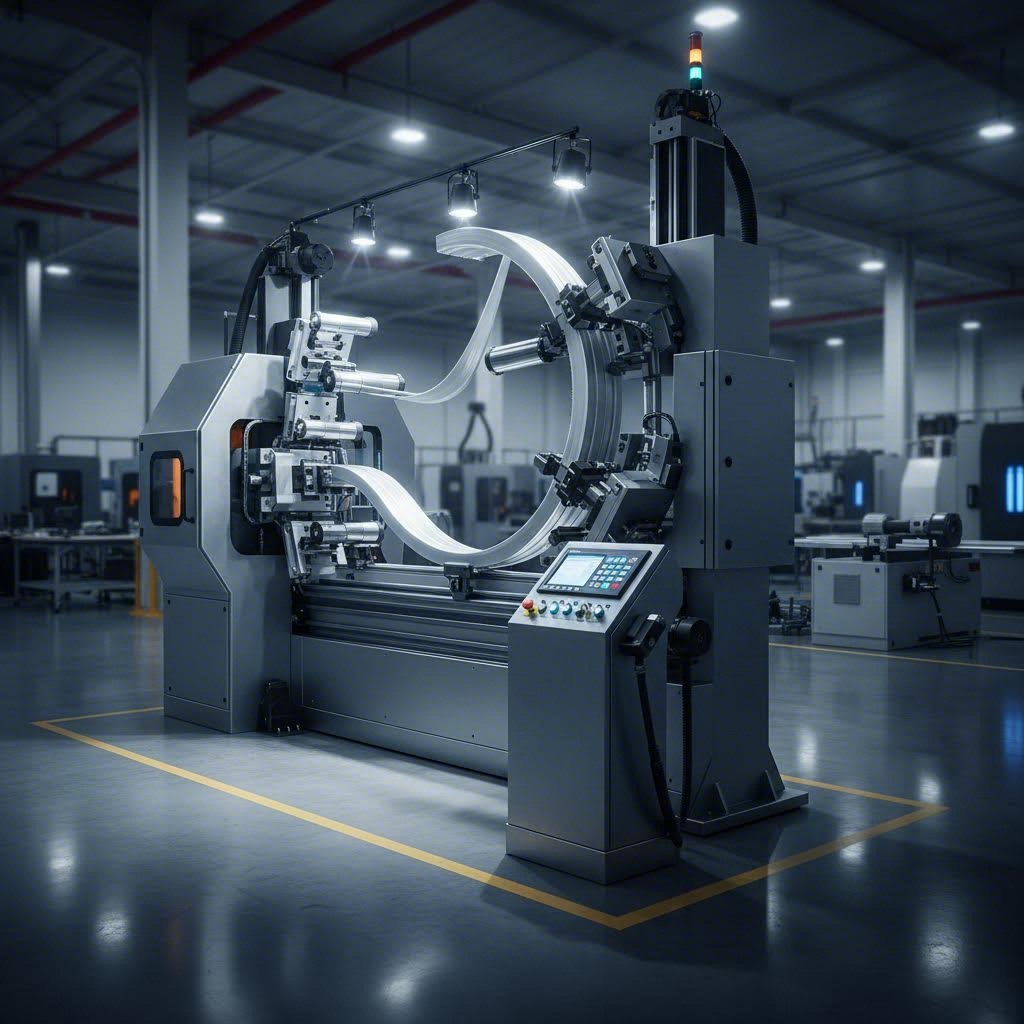
When you're working with curved aluminum extrusion profiles, standard metal fabrication equipment simply won't deliver the precision you need. That's where specialized bending equipment comes into play. But what exactly sets these machines apart from conventional benders?
An aluminum extrusion bending machine is specialized fabrication equipment engineered specifically to curve, arc, and shape extruded aluminum profiles while preserving their structural integrity, dimensional accuracy, and surface finish quality.
Unlike general-purpose metal bending tools, an aluminum bending machine addresses the distinct metallurgical characteristics that make extruded profiles behave differently under stress. These machines incorporate precision tooling, controlled force application, and often specialized support systems designed exclusively for aluminum's unique response to deformation.
Bending aluminum presents challenges you won't encounter with steel or other metals. Aluminum exhibits significant springback—meaning the material partially returns toward its original shape after bending force is released. This property demands machines capable of precise overbending compensation.
Additionally, aluminum's surface sensitivity requires careful handling. The anodized or mill-finished surfaces common on extruded profiles scratch and mar easily during processing. Specialized equipment incorporates non-marking dies, protective inserts, and controlled material handling to maintain aesthetic quality throughout the bending process.
The material's malleability, while beneficial for forming, also increases the risk of unwanted deformation. Hollow profiles and complex cross-sections can collapse, wrinkle, or distort without proper internal support during bending operations.
A properly equipped aluminum bending machine typically includes several key components working together:
Selecting the right equipment requires understanding how these components interact with your specific profile complexity. The wrong machine choice leads to rejected parts, wasted material, and production delays—making proper selection essential for efficient aluminum fabrication operations.
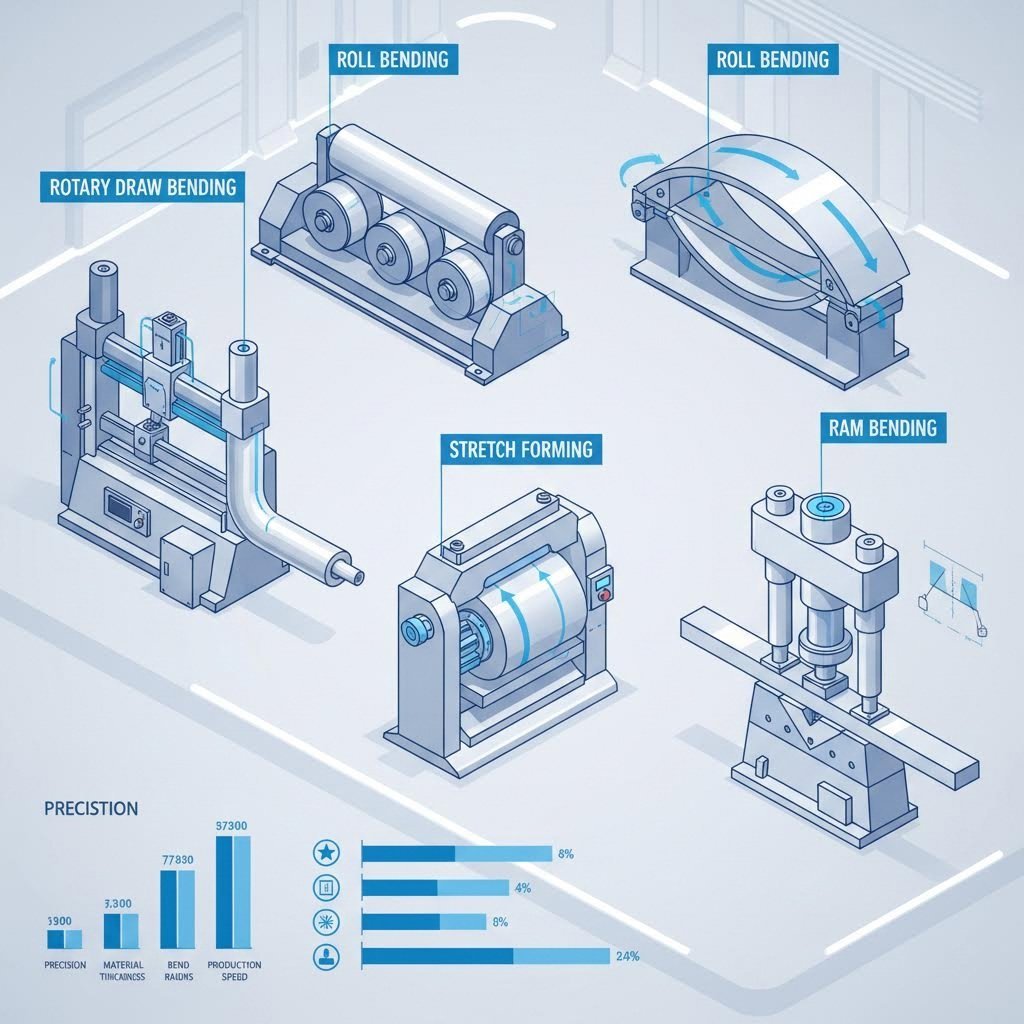
Choosing the right equipment for aluminum profile bending starts with understanding what each machine type does best. Think of it this way—you wouldn't use a sledgehammer when you need a scalpel. The same principle applies here. Each bending technology excels in specific applications, and matching your profile requirements to the appropriate machine category saves time, reduces waste, and delivers consistent results.
Let's explore the four primary machine categories you'll encounter when working with aluminium bending operations.
When precision matters most, rotary draw bending delivers. This technology wraps the aluminum profile around a rotating die while a pressure die holds the material firmly against the form. Imagine bending a straw around your finger—the principle is similar, but with far greater control and accuracy.
Rotary draw machines excel at producing tight-radius bends with minimal distortion. They're the go-to choice for architectural handrails, furniture frames, and automotive components where appearance and dimensional accuracy are critical. The process supports the use of internal mandrels, making it ideal for hollow profiles that would otherwise collapse under bending stress.
You'll find these machines handling centerline radii as tight as one times the tube diameter—something other bending methods struggle to achieve without significant quality compromises.
Need sweeping curves for structural applications or architectural features? Roll bending systems handle large-radius work efficiently. These machines pass the aluminum profile through a series of rollers that progressively introduce curvature along the workpiece length.
Three-roll configurations position two fixed rollers with one adjustable roller that controls the bend radius. This setup works well for moderate-complexity profiles and offers straightforward operation. Four-roll systems add another adjustment point, providing greater control over the entry and exit angles—particularly useful when you need consistent curvature from end to end.
Roll bending shines when producing curved aluminum extrusion components for canopies, curved curtain wall framing, and circular structures. The process handles longer profile lengths than most other methods and produces gradual, uniform curves rather than localized bends.
What happens when you're working with asymmetric or intricate cross-sections that would distort under conventional bending? Stretch forming offers a solution. This process grips both ends of the aluminum profile and applies tensile force while simultaneously wrapping the material over a form die.
The stretching action keeps the entire cross-section under tension during forming, which virtually eliminates the compression-side wrinkling that plagues other bending methods. Aircraft fuselage frames, complex architectural trim, and transportation components frequently rely on stretch forming for this reason.
The trade-off? Stretch forming requires dedicated tooling for each profile shape and bend configuration, making it more economical for production runs rather than prototype quantities.
Sometimes simplicity wins. Ram bending—also called press bending or compression bending—uses a straightforward approach: a hydraulic or mechanical ram pushes the aluminum profile against two fixed supports, creating a bend at the contact point.
This method works best for aluminium profile bending applications requiring basic angular bends rather than smooth curves. Think bracket fabrication, simple frame corners, or utility applications where tight tolerances aren't the primary concern. Ram bending equipment typically costs less than other options and offers quick changeover between different bend angles.
The limitation? Ram bending produces less consistent results on complex profiles and tends to cause more distortion than rotary draw or stretch forming methods.
How do these four technologies stack up against each other? The following comparison helps clarify which approach fits your specific aluminum bending requirements:
| Machine Type | Typical Applications | Radius Capability | Profile Complexity Suitability | Production Speed | Relative Cost |
|---|---|---|---|---|---|
| Rotary Draw Bending | Handrails, furniture, automotive tubes, precision components | Tight to medium (1D to 3D CLR) | High—handles hollow and multi-void profiles well | Moderate—setup-intensive but consistent | Medium to High |
| Roll Bending | Architectural curves, structural rings, canopy frames | Large radius curves (typically 8D+ CLR) | Moderate—best for symmetric profiles | Fast for long sweeping curves | Low to Medium |
| Stretch Forming | Aircraft frames, complex architectural trim, transportation | Medium to large radius | Excellent—ideal for asymmetric and complex shapes | Slower—requires dedicated tooling | High |
| Ram Bending | Brackets, simple frames, utility components | Angular bends rather than curves | Low—basic profiles only | Fast for simple bends | Low |
Understanding these fundamental machine categories provides the foundation for informed equipment decisions. However, the control system you choose—whether CNC or manual—adds another critical layer to consider.
You've identified the right machine type for your aluminum bending application—but that's only half the equation. The control system running that equipment shapes everything from production consistency to operator requirements and long-term ROI. Should you invest in aluminum extrusion CNC capabilities, or does a manual system better fit your operation?
This decision impacts more than just the purchase price. It influences daily workflow, staffing needs, quality consistency, and your ability to scale production when demand grows.
Imagine running the same complex bend sequence dozens of times daily with virtually identical results every cycle. That's the core advantage CNC aluminium extrusion equipment brings to manufacturing operations.
CNC-controlled bending machines store programmed bend sequences digitally, eliminating the variability that comes with manual adjustments. Once you've dialed in the parameters for a specific profile and bend configuration, the machine reproduces those settings precisely—bend after bend, shift after shift.
This repeatability becomes critical in several scenarios:
Modern CNC aluminum bending equipment also integrates seamlessly with CAD/CAM workflows. You can import bend data directly from design files, reducing programming time and minimizing transcription errors that occur when manually entering specifications.
CNC capability comes at a price—both in equipment cost and operational complexity. Manual bending systems offer a compelling alternative when your production profile doesn't demand automated precision.
Consider manual equipment when you're handling diverse, low-volume work. Job shops processing one-off prototypes or small batches often find that the time spent programming CNC sequences exceeds the time saved during actual bending. A skilled operator working with manual controls can adjust on the fly, making quick corrections based on visual feedback without cycling through software menus.
The investment difference is substantial. Manual bending machines typically cost 40-60% less than comparable CNC-equipped models. For operations with limited capital or uncertain production forecasts, this lower entry point reduces financial risk while still providing capable aluminum bending capacity.
Manual systems also present a gentler learning curve for new operators. While CNC equipment requires training in both machine operation and programming software, manual machines focus operator development on fundamental bending techniques and material behavior—skills that remain valuable regardless of future equipment upgrades.
How do you determine which approach fits your specific situation? The following decision factors help clarify the choice:
Neither option is universally superior. The right choice depends on matching control system capabilities to your actual production requirements—not theoretical ideal scenarios. Many successful operations start with manual equipment, develop their processes, then transition to CNC as volume and complexity justify the investment.
Of course, the control system works hand-in-hand with your profile characteristics. Understanding how specific profile geometries influence machine selection adds another essential dimension to your equipment decision.
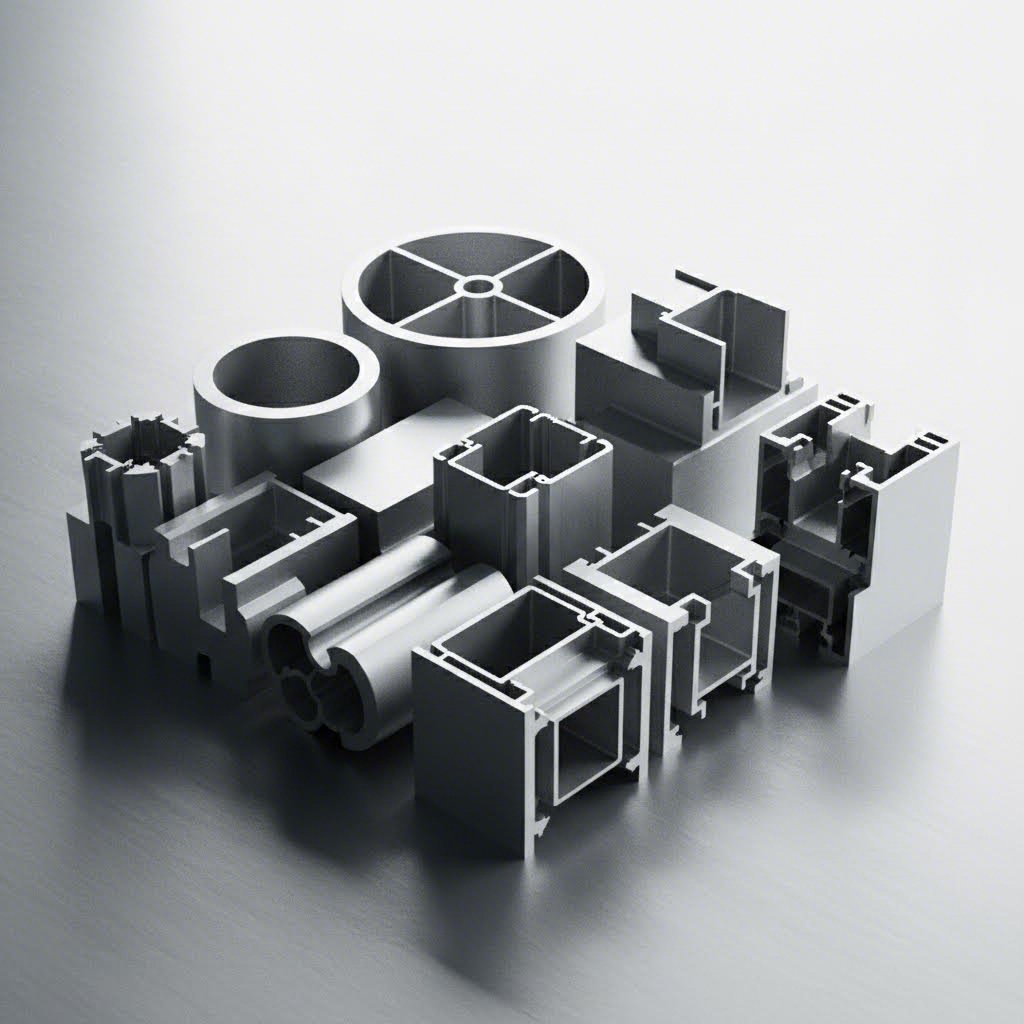
Here's where theory meets reality. You've learned about machine types and control systems—but how do you actually match your specific aluminum extrusion to the right bending equipment? The answer lies in understanding how profile geometry, wall characteristics, and alloy selection intersect with machine capabilities.
Think of it this way: a simple solid bar and a complex multi-void architectural extrusion might both be aluminum, yet they demand entirely different approaches when bending aluminum extrusions. Let's break down the critical factors that drive equipment selection.
Profile geometry is your starting point for equipment selection. Each cross-sectional shape presents distinct challenges during the bending process, and understanding these challenges prevents costly trial-and-error on the shop floor.
Solid profiles represent the simplest category. Round bars, rectangular stock, and basic solid shapes bend predictably because there's no internal void to collapse. These profiles work well across most machine types, with equipment selection driven primarily by radius requirements and production volume rather than profile support concerns.
Hollow profiles introduce complexity immediately. Tubes, square sections, and rectangular hollow profiles contain unsupported internal space that wants to collapse under bending stress. The compression side of the bend pushes inward while the tension side pulls outward—and without internal support, the cross-section deforms. Rotary draw machines equipped with mandrels excel here, providing internal support that maintains shape integrity through the bend.
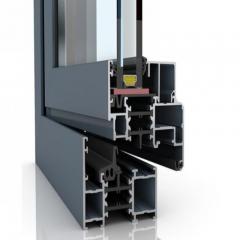
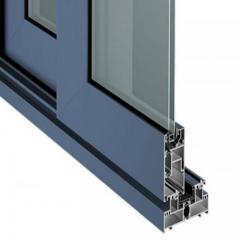
Multi-void extrusions take this challenge further. Imagine bending aluminium extrusion profiles with multiple internal chambers—common in window frames, curtain wall systems, and structural applications. Each void requires consideration. Standard mandrel support becomes impractical when you're dealing with complex internal geometries. Stretch forming often provides the best solution, as the tensile loading keeps all sections under positive stress during forming.
Asymmetric shapes present unique material flow challenges. When the cross-section isn't balanced around its neutral axis, bending forces cause twisting and warping alongside the intended curvature. Equipment selection must account for this tendency. Stretch forming handles asymmetric aluminium extrusion types particularly well because the stretching action counteracts distortion tendencies. Rotary draw machines can work with asymmetric profiles when equipped with precisely matched tooling and wiper dies that control material flow.
Wall thickness directly impacts your machine and tooling requirements. Thin-walled profiles—typically those with wall thickness less than 2mm—require more sophisticated support during bending. They're prone to wrinkling on the inside radius and flattening across the bend. Thicker walls provide more inherent stability but demand greater machine capacity to achieve the same bend radius.
The ratio between wall thickness and overall profile dimension matters significantly. A 50mm tube with 1.5mm walls behaves very differently than the same tube with 3mm walls. Thinner relative wall thickness means you'll likely need mandrel support, wiper dies, and precisely controlled pressure die force to prevent defects.
Alloy selection connects directly to bending equipment parameters. The two most common aluminum extrusion types you'll encounter—6063 and 6061—respond differently to bending operations:
Temper condition dramatically affects bendability—and timing matters. Material in T4 temper (solution heat-treated but not artificially aged) bends more easily than T6 temper (fully aged). Some fabricators specify T4 delivery for bending operations, then perform T6 aging after forming. This approach requires coordinating your bending machine operation with heat treatment schedules, but it opens possibilities for tighter radii and more complex shapes than fully hardened material allows.
When profiles arrive in T6 condition and tight bends are required, some operations perform annealing (O temper) before bending, by solution treatment and aging to restore mechanical properties. Your equipment selection should account for whether you're processing soft, intermediate, or fully hardened material.
The following table consolidates profile characteristics with recommended machine types and critical considerations for bending aluminum extrusions:
| Profile Type | Recommended Machine Types | Key Considerations | Typical Applications |
|---|---|---|---|
| Solid bars and shapes | Roll bending, Rotary draw, Ram bending | Machine capacity based on cross-section size; minimal support tooling needed | Handles, brackets, structural members |
| Simple hollow tubes (round, square) | Rotary draw with mandrel, Roll bending (large radius) | Mandrel sizing critical; wall thickness ratio determines support requirements | Handrails, furniture frames, roll cages |
| Rectangular hollow sections | Rotary draw with shaped mandrel, Stretch forming | Orientation affects wrinkling tendency; may need custom mandrel profiles | Window frames, structural frames, enclosures |
| Multi-void extrusions | Stretch forming, Specialized rotary draw | Internal support often impractical; stretch forming preferred for quality | Curtain wall frames, thermal break profiles |
| Asymmetric/complex shapes | Stretch forming, CNC rotary draw | Twist control essential; may require compound tooling and precise pressure control | Architectural trim, aircraft components, automotive |
| Thin-wall profiles (<2mm) | Rotary draw with full tooling, Stretch forming | Maximum support required; wiper dies essential; surface protection critical | Decorative trim, lightweight structures |
| Thick-wall profiles (>4mm) | Heavy-duty rotary draw, Industrial roll bending | Machine tonnage capacity primary concern; springback compensation important | Structural applications, heavy equipment |
Notice how profile complexity increasingly narrows your viable equipment options. Simple shapes offer flexibility in machine selection, while complex geometries demand specific technologies. This reality underscores why understanding your profile mix before equipment investment prevents capability gaps that limit your production possibilities.
Even with the right machine matched to your profile complexity, bending defects can still emerge. Understanding common quality issues and how machine selection influences their prevention helps you anticipate challenges before they impact production.
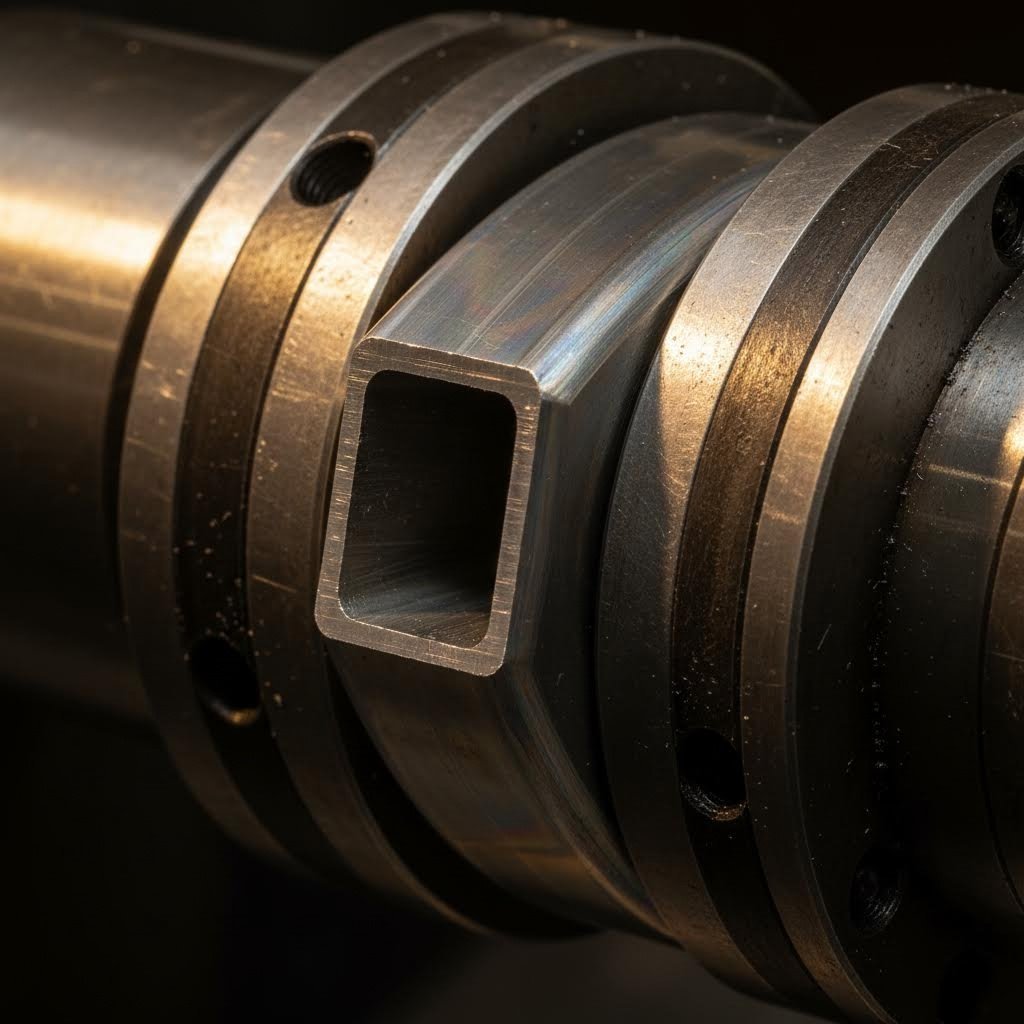
You've matched your profile to the right machine type—but curved aluminum extrusions can still go wrong during production. Wrinkling, springback, cracking, and deformation don't just happen randomly. Each defect traces back to specific causes, and more importantly, each has machine-based solutions that prevent rejected parts before they happen.
Understanding these quality challenges transforms your equipment from a simple forming tool into a precision system that consistently delivers acceptable parts. Let's examine the most common defects and how proper machine selection and setup address each one.
Wrinkling appears on the inside radius of bends—the compression side where material bunches up as the profile curves. Picture squeezing a drinking straw around your finger. That accordion-like deformation on the inner curve? That's wrinkling, and it's one of the most frequent challenges in aluminium extrusion bending operations.
Why does it happen? During bending, the outer radius stretches while the inner radius compresses. When compressive stress exceeds the material's stability threshold, the profile buckles into wrinkles. Thin walls, tight radii, and hollow profiles amplify this tendency significantly.
Mandrel systems provide the primary defense against wrinkling in hollow profiles. These internal supports—inserted into tubes and hollow sections before bending—prevent the inside wall from collapsing inward. Ball mandrels with articulating segments work best for tight-radius bends, flexing through the curve while maintaining consistent internal support. Plug mandrels suit larger radii where less support is needed.
Proper mandrel positioning matters as much as mandrel selection. Placed too far back from the bend tangent point, the mandrel leaves unsupported material vulnerable to collapse. Positioned too far forward, it restricts material flow and increases friction. Most applications require mandrel nose placement within one wall thickness of the tangent point.
Pressure die technique adds another layer of wrinkle prevention. The pressure die holds the profile against the bend die throughout the forming operation. Insufficient pressure allows the profile to lift and buckle. Excessive pressure causes different problems—galling, surface damage, and restricted material flow. Modern CNC bending equipment offers programmable pressure die force that adjusts through the bend cycle, optimizing support as conditions change.
Wiper dies tackle wrinkling from a different angle. Positioned directly behind the tangent point, these thin blade-like tools physically prevent material from buckling outward on the compression side. They're essential for tight-radius bends where mandrels alone can't fully control material behavior. The wiper die must match your profile geometry precisely—generic tooling simply won't provide adequate support for complex cross-sections.
Here's a frustrating reality: aluminum doesn't stay exactly where you bend it. Release the forming pressure, and the profile partially returns toward its original straight condition. This elastic recovery—springback—means your programmed bend angle and your actual finished angle differ.
Springback varies with alloy, temper, profile geometry, and bend radius. Harder tempers like T6 exhibit more springback than softer T4 material. Tighter radii typically produce greater springback than sweeping curves. And frustratingly, springback isn't always consistent even within the same production run as material properties vary slightly.
Overbending provides the fundamental solution. Program your bending equipment to exceed the target angle by an amount that accounts for expected elastic recovery. When the profile springs back, it lands at your intended specification. Sounds simple—but determining the correct overbend amount requires experience, testing, or sophisticated prediction models.
CNC-controlled equipment excels at springback management. These machines store compensation values for specific profile and alloy combinations, applying consistent overbending automatically. Some advanced systems incorporate real-time angle measurement, adjusting compensation dynamically based on actual measured results rather than predetermined values.
Boost pressure represents another compensation strategy available on some rotary draw equipment. By applying additional pressure die force during the final portion of the bend cycle, the machine increases plastic deformation in the profile, reducing the elastic component that drives springback.
For curved extruded aluminum requiring precise radius control, multi-pass bending sometimes provides better results than attempting the full curve in one operation. Incremental forming distributes stress more evenly and can reduce total springback compared to aggressive single-pass approaches.
Surface cracking signals that you've exceeded the material's ductility limits. The outer radius of a bend experiences tensile stress—stretching forces that eventually cause fracture if pushed too far. Cracks typically appear on the tension side, running perpendicular to the bend axis.
Several factors contribute to cracking in aluminum bending operations:
Machine selection influences cracking prevention primarily through radius capability and forming speed control. Equipment that supports internal mandrels allows tighter radii than unsupported bending. Machines with variable speed control let operators slow through critical portions of the bend, reducing instantaneous stress peaks that trigger fracture.
Cross-sectional deformation—flattening, ovalization, and general shape distortion—relates directly to tooling and support within the bending system. Hollow profiles want to flatten across bends as forces redistribute during forming. Without properly sized mandrels and precisely matched clamp and pressure dies, the finished profile may meet angle specifications but fail dimensional requirements for the cross-section itself.
Die design within your machine system directly prevents these deformation issues. Clamp dies must grip the profile firmly without crushing or marking. Bend dies need accurate groove geometry that fully captures the profile shape. And pressure dies require surface profiles that support the entire visible face of the extrusion through the forming operation.
When quality issues emerge in production, systematic diagnosis leads to faster resolution. The following reference connects common bending defects with their typical causes and machine-based solutions:
Proper tooling investment often determines whether your bending equipment produces quality curved aluminum extrusions or generates scrap. Generic dies and mandrels rarely deliver acceptable results on anything beyond the simplest profiles. Custom tooling matched precisely to your profile geometry costs more upfront but pays dividends in reduced rejection rates and consistent quality.
With defect prevention strategies in place, the next consideration becomes production efficiency—how volume requirements influence both machine selection and your return on equipment investment.
Here's a question that separates smart equipment buyers from those stuck with underutilized machinery: how many bent profiles will you actually produce? Your answer shapes everything from machine type to control system complexity—and ultimately determines whether that equipment investment pays off or drains resources.
Production volume isn't just about counting parts. It influences cycle time requirements, changeover frequency, automation justification, and even when you schedule surface finishing operations. Let's break down how volume considerations should drive your aluminum benders selection.
Prototype work and small-batch production create a fundamentally different equipment calculus than high-volume manufacturing. When you're bending 50 pieces today and 30 completely different profiles tomorrow, flexibility trumps speed every time.
What does flexibility look like in an aluminum folding machine or bending system? Quick changeover capability tops the list. Equipment that requires hours of die changes and recalibration between jobs kills productivity in batch environments. Look for machines with modular tooling systems, quick-release clamps, and straightforward adjustment mechanisms that minimize non-productive time.
Manual control systems often make more sense for batch operations. Remember—programming a CNC sequence for a 25-piece run may take longer than simply bending those parts with skilled operator control. The economics shift dramatically when you're not amortizing setup time across thousands of identical pieces.
Batch production also favors equipment versatility over specialization. A rotary draw machine with interchangeable die sets handles tubes, rectangles, and various profile shapes—adapting to whatever your job mix demands. Dedicated stretch forming equipment, by contrast, excels at specific complex profiles but sits idle when those jobs aren't running.
Surface finishing timing matters for batch efficiency as well. Post-bending operations like anodizing or powder coating typically require accumulating sufficient quantities for economical processing. Your machine handling and fixturing should minimize marking and contamination that could compromise finish quality—even when parts wait between bending and finishing stages.
Shift to continuous production scenarios and priorities invert completely. When you're producing thousands of identical curved profiles monthly, cycle time becomes the dominant metric. Every second saved per part multiplies across your entire production volume.
High-volume operations justify—and often require—significant automation investment. CNC control isn't optional when consistency across 10,000 parts matters. Automated loading and unloading systems eliminate operator handling time. Integrated measurement stations catch deviations before they become batch-wide problems.
An aluminium pipe bending machine or profile bending system in high-volume service needs robust construction that maintains accuracy through continuous operation. Lighter-duty equipment designed for intermittent use degrades quickly under production pace demands. Hydraulic systems require adequate cooling capacity. Mechanical components need proper sizing to handle accumulated cycle counts without premature wear.
Automation integration extends beyond the bending machine itself. Consider how bent profiles move to downstream operations. Conveyors, robotic handling, and automated stacking systems connect bending into larger production flow. Your equipment selection should account for these integration requirements—some machines accommodate automation retrofits better than others.
The relationship between production volume and return on investment follows predictable patterns. Higher-capability equipment costs more but processes parts faster with less labor. At low volumes, the math rarely works—you can't recover the premium through production savings. Cross the volume threshold where cycle time reduction and labor savings compound, and premium equipment becomes the economical choice.
Systematic evaluation prevents both over-investment and capability shortfalls. Follow this step-by-step process to match equipment investment to your actual production needs:
This structured approach prevents emotional equipment decisions driven by impressive specifications rather than actual production needs. The fanciest CNC aluminum bending system delivers no value if your volume never justifies its capabilities—while undersized equipment creates bottlenecks that constrain your entire operation.
Once you've selected equipment matched to your volume requirements, maintaining that investment becomes the next priority. Proper care directly affects both bend quality consistency and equipment longevity.
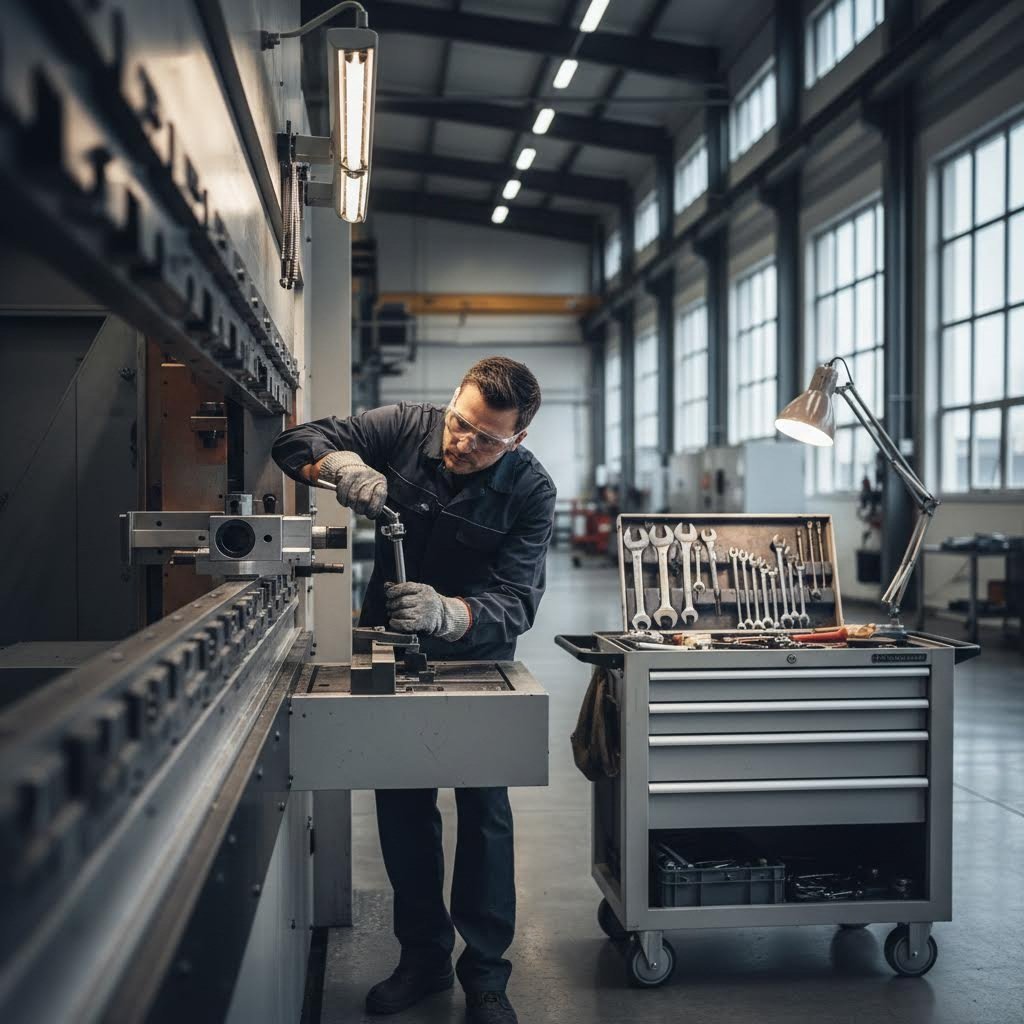
Your bending equipment represents a significant investment—but that investment only pays off when machines run reliably and produce consistent results. Neglected maintenance doesn't just shorten equipment life; it degrades bend quality gradually until rejected parts pile up and unplanned downtime disrupts your production schedule.
Whether you're operating a simple aluminium bending tool or a sophisticated CNC system, proper care follows predictable patterns. Understanding these requirements before equipment arrives helps you plan workspace needs, staff training, and ongoing operational budgets.
Every bending machine—regardless of type or control system—requires attention to several core maintenance areas. Skip these fundamentals and you'll notice quality degradation long before mechanical failure announces itself.
Lubrication schedules vary by machine design, but all bending equipment contains moving components that require proper lubrication. Guide rails, pivot points, and drive mechanisms need regular grease or oil application according to manufacturer specifications. Under-lubrication accelerates wear; over-lubrication attracts contamination that causes its own problems. CNC machines often include automated lubrication systems that require reservoir monitoring rather than manual application.
Die inspection catches problems before they transfer to your parts. Examine bend dies, clamp dies, and pressure dies for wear patterns, galling, surface contamination, and dimensional changes. Even minor die surface damage produces visible marks on aluminum profiles. Mandrels require similar attention—worn mandrel segments cause inconsistent internal support that shows up as variable wall thickness or subtle wrinkling in finished bends.
Hydraulic system care affects machines using hydraulic power for clamping, forming, or both. Monitor fluid levels and condition regularly. Contaminated hydraulic fluid degrades seals, clogs valves, and reduces system responsiveness. Most manufacturers specify fluid change intervals and filter replacement schedules—follow these recommendations rather than waiting for performance problems to emerge.
Calibration requirements ensure your machine produces the angles and radii you program. Rotary encoders, angle sensors, and position feedback systems drift over time. Regular calibration verification—and adjustment when needed—maintains the accuracy that justifies your equipment investment. CNC systems typically include calibration routines; manual equipment requires gauge verification against known standards.
Maintenance needs do vary between machine types. Roll bending systems demand attention to roller alignment and bearing condition. Rotary draw machines require more frequent tooling inspection due to higher contact pressures. Stretch forming equipment needs hydraulic cylinder seal monitoring and grip jaw inspection. Match your maintenance program to your specific equipment configuration.
Proper maintenance means nothing if operators don't understand safe, effective machine operation. Metal forming environments present real hazards—and comprehensive training protects both your team and your equipment.
According to industry safety research, implementing proper safety protocols in metal forming operations has demonstrated measurable results, with some facilities achieving 40% reductions in workplace accidents after comprehensive program implementation.
Essential training elements include machine-specific operation procedures, emergency stop locations and proper use, material handling techniques that prevent injury and profile damage, and recognition of abnormal machine behavior indicating maintenance needs. Refresher training keeps safety awareness current as procedures evolve and new staff join operations.
Personal protective equipment requirements for aluminum bending typically include safety glasses, hearing protection in high-noise environments, and appropriate gloves when handling raw material with sharp edges. Steel-toed footwear protects against dropped profiles or tooling.
Workspace requirements influence both safety and equipment performance. Adequate floor space allows safe material handling and operator movement. Sufficient ceiling height accommodates long profile lengths during loading. Proper ventilation matters when using cutting fluids or lubricants. Power supply capacity must match equipment demands—undersized electrical service causes performance issues and potential safety hazards.
Organizing bending machine care into scheduled tasks prevents overlooked items and distributes workload across operating periods:
Consistent execution of these maintenance tasks directly affects bend aluminium quality over time. Equipment that receives proper care maintains tighter tolerances, produces fewer defects, and operates reliably through production demands. The small daily time investment in aluminum bending equipment maintenance prevents major repairs and quality failures that cost far more than the maintenance effort itself.
With your equipment properly maintained and operators trained, you're positioned to evaluate whether in-house bending makes sense—or whether partnering with experienced processors offers advantages for your specific situation.
You've explored machine types, control systems, profile matching, defect prevention, and maintenance requirements. Now comes the pivotal question: should you invest in your own aluminum bending solution, or does partnering with an established aluminum processing partner make more sense for your operation?
This isn't a one-size-fits-all answer. Your decision depends on production volumes, capital availability, technical capabilities, and strategic priorities. Let's work through the evaluation process so you can make a confident, informed choice.
Before comparing equipment quotes or contacting aluminum extrusion services providers, step back and honestly assess your actual bending needs. Many manufacturers either over-invest in capabilities they rarely use or underestimate requirements that later constrain their operations.
Start by documenting your profile mix. How many distinct aluminum profiles will you bend? What are their geometries—simple tubes, complex architectural sections, or multi-void extrusions? This diversity directly impacts equipment complexity and tooling investment.
Volume patterns matter significantly. Are you processing steady quantities monthly, or does demand spike unpredictably? Consistent high-volume work justifies capital equipment investment. Sporadic or project-based needs often favor outsourcing flexibility.
Consider your tolerance requirements carefully. Custom aluminum bending for precision aerospace components demands different capabilities than general architectural work. Tighter specifications mean more sophisticated equipment, more skilled operators, and more rigorous quality systems.
Technical capability assessment comes next. Do you have—or can you develop—the expertise to operate bending equipment effectively? According to industry analysis, many industries face long-term shortages of qualified CNC operators, certified welders, and trained machinists. Recruiting, training, and retaining technical staff can significantly increase operational costs beyond equipment investment alone.
Here's a reality many manufacturers overlook: bringing bending in-house means more than purchasing equipment. You're building an entire capability—tooling libraries, maintenance programs, quality systems, and trained personnel. That's substantial overhead for operations where bending isn't a core competency.
Outsourcing to specialized processors eliminates capital investment while providing access to capabilities that would take years to develop internally. Established aluminum processing partners have already solved the equipment selection puzzle, invested in diverse tooling, and developed the expertise to handle complex profiles efficiently.
What should you look for in an aluminum processing partner? Experience depth matters tremendously. Processors with decades of aluminum extrusion work understand material behavior, anticipate challenges, and deliver consistent results. According to supplier evaluation research, top-tier suppliers offer engineering collaboration, quality assurance, and integrated production capabilities that align with your business goals.
Companies like Shengxin Aluminium exemplify this integrated approach—offering CNC machining centers capable of precise bending alongside comprehensive extrusion services. With over 30 years of experience and technical team support from die development through finished bent profiles, such partners provide end-to-end capabilities without requiring your capital investment in specialized equipment.
Scalability represents another outsourcing advantage. When order volumes increase, a reliable processing partner can expand output without you worrying about internal capacity bottlenecks. This flexibility proves invaluable during demand surges or when entering new markets.
The in-house versus outsourcing decision isn't binary—many successful manufacturers use hybrid approaches, handling routine work internally while partnering with specialists for complex or overflow requirements.
In-house fabrication typically makes sense when your business handles consistent high-volume production, requires rapid design iterations, or processes proprietary designs requiring strict confidentiality. Outsourcing aligns better with variable demand patterns, limited capital availability, or situations where bending represents a small portion of overall production activity.
Use the following criteria when deciding between equipment investment and processing partnerships:
Whatever path you choose, remember that successful aluminum profile bending depends on matching capabilities to requirements. Whether those capabilities reside in your facility or with a trusted processing partner, the fundamentals remain constant: proper equipment for your profile complexity, appropriate control systems for your production patterns, and consistent quality management that delivers reliable results.
Take time to evaluate honestly, request samples from potential partners, and make decisions based on total value rather than any single factor. The right aluminum bending solution positions your operation for efficient, quality production—today and as your requirements evolve.
An aluminum extrusion bending machine is specialized fabrication equipment engineered to curve, arc, and shape extruded aluminum profiles while preserving structural integrity, dimensional accuracy, and surface finish quality. Unlike general metal bending tools, these machines incorporate precision tooling, controlled force application, and specialized support systems designed for aluminum's unique properties including springback tendency, malleability, and surface sensitivity.
Four primary machine types handle aluminum profile bending: Rotary draw bending for tight-radius precision work with hollow profiles; Roll bending systems for large-radius sweeping curves in architectural applications; Stretch forming machines for complex asymmetric profiles where material is stretched over dies; and Ram bending for simple angular bends in basic applications. Each technology excels in specific applications based on radius capability, profile complexity, and production requirements.
CNC control delivers value for high-volume production, complex multi-bend geometries, tight tolerance requirements, and quality documentation needs. Manual systems offer lower investment costs, greater flexibility for diverse low-volume work, and gentler learning curves for operators. The right choice depends on your production volume, part complexity, available workforce skills, and budget constraints. Many operations start manual and upgrade to CNC as volume justifies the investment.
Wrinkling prevention requires mandrel systems for internal support, proper pressure die technique, and wiper dies for tight-radius bends. Springback management uses overbending compensation and boost pressure techniques. Surface cracking is avoided by matching bend radius to material capabilities, using fresh material, and controlling forming speed. Proper tooling investment matched precisely to your profile geometry significantly reduces rejection rates and ensures consistent quality.
In-house bending makes sense for consistent high-volume production, rapid design iterations, and proprietary designs requiring confidentiality. Outsourcing to experienced processors like Shengxin Aluminium benefits operations with variable demand, limited capital, or where bending represents a small portion of production. Partners with 30+ years experience offer integrated services from die development through finished bent profiles, eliminating capital investment while providing access to advanced capabilities.



 Onlineservice
 0086 136 3563 2360
 sales@sxalu.com
 +86 136 3563 2360
 Deutsch
 English
 français
 русский
 español
 português
 العربية
 ไทย
ไทย Việt
Việt Українська